



Published: Nov 22, 2026
What Is the DAM Maturity Model? The Five Levels and How to Assess Your Team
Table of contents
Where the DAM maturity model came from
The five levels of DAM maturity
Other DAM maturity models you might come across
Air's take on assessing DAM maturity for creative and marketing teams
How to assess your team's DAM maturity
Move up a level without rebuilding from scratch
DAM maturity model FAQs
A DAM maturity model scores how your assets, metadata, workflows, and ownership actually function day to day, whatever software sits underneath them. The modern catch is that a disorganized library now limits AI as well as people, because search, tagging, and agents can realistically only act on assets that have context.
This guide covers the original DAM Maturity Model from Real Story Group and the DAM Foundation, its five levels, the vendor models that have appeared since, and a simpler five-stage version Air built for creative and marketing teams, with what to fix first at each stage.
If you only have a minute, start with the table below.
Air's model for the five stages of DAM maturity
Stage | What it looks like day to day | Main cost | Next move |
1: Scattered | Assets sit across drives, Slack, email, and laptops, and no single search covers them all | Duplicated work and designers acting as human search engines | Inventory every source, clear out duplicates, then consolidate |
2: Stored | Everything is in one place, but search depends on filenames | A central library nobody trusts, so people drift back to personal folders | Make the backlog searchable with AI tagging |
3: Searchable | Marketing finds assets by describing them | Assets turn up, but nobody can tell which version is approved or cleared for use | Add structured metadata, define "approved," and name sign-off owners |
4: Governed | The approved version is obvious, feedback lives on the file, and permissions are set on purpose | Approved work gets reused by hand, one request at a time | Keep approval status, rights, and brand rules on each asset so search and agents can act on them |
5: AI-ready | The library carries enough context for search and agents to act on it reliably | Value stalls if adoption and reuse aren't measured | Measure reuse and make every new asset findable on day one |
Where the DAM maturity model came from
The DAM maturity model is a diagnostic framework that rates the practices around your assets so you can benchmark where you are, plan a roadmap, and justify investment.
Real Story Group and the DAM Foundation published the model in 2012. That release had 16 dimensions across three categories. This guide refers to version 2.1, which defines five maturity levels and groups 15 dimensions into four categories:
People: technical expertise, business expertise, and alignment
Information: assets, metadata, reuse, findability, and use cases
Systems: prevalence, security, usability, and infrastructure
Processes: workflow, governance, and integration
The practical point is that maturity is uneven. Your team can be strong on Systems and weak on Information, with a secure, widely used platform full of assets nobody tagged, so scoring each dimension tells you more than one overall level. Maturity also varies by department, workflow, and asset type: product photography may be well governed while video and UGC still live in someone's Dropbox.
The five levels of DAM maturity
The model runs from asset management that depends on individual habits to asset operations that are governed, measured, and integrated.
Level 1: Ad hoc
No one owns the library. Assets sit in personal drives and shared folders, naming is left to whoever uploaded the file, and there's no metadata standard. Marketing teams can't find approved work without asking design teams, and assets get recreated because no one knows they already exist.
Level 2: Incipient
A few people start fixing the problem locally: one team builds a folder convention, while someone else keeps a spreadsheet of final assets. Progress stalls here because the improvements still depend on individuals, so when one of them leaves, their system leaves too.
Level 3: Formative
A system is in place with basic taxonomy and naming rules. The main gap here is adoption: governance is informal and only some teams use it, so the system holds part of the truth while Slack and email hold the rest.
Level 4: Operational
Ownership is assigned, metadata is consistent, approval steps are documented, permissions are deliberate, and the DAM connects to the tools teams already use. The library becomes the source of truth, self-serve access works, and asset requests stop routing through the creative team.
Level 5: Optimal
Adoption is measured, usage and rights are tracked, and archiving and retirement are routine. Reuse is also deliberate. Few teams sit at Level 5 across all 15 dimensions, and they don't necessarily need to: the goal is targeted improvement where you need it most.
Other DAM maturity models you might come across
Several vendors have published their own models, so check which one a stakeholder means before you compare scores. Two you're likely to see:
MediaValet's model uses four stages: Chaotic, Compartmentalized, Collaborative, and Connected. It compresses the progression into fewer stages that are likely easier to explain in a leadership meeting.
Acquia's Brand Management Maturity Model looks at maturity through a brand management lens, and in 2026 it added AI readiness as a sixth dimension.
Newer models increasingly treat AI readiness as its own axis of maturity, which we also include for our model. Whichever model you choose, stick with it, because a "Level 3" in one framework doesn't necessarily line up with a "stage 3" in another, and mixing them makes year-over-year comparison meaningless.
Air's take on assessing DAM maturity for creative and marketing teams
The following stages are our own simplified framework, separate from the Real Story Group model and written for the creative and marketing teams who use the library every day.
Each stage is also judged partly on whether search, tagging, and agents have enough context to act on your library.
Stage 1: Scattered
Assets are split across Google Drive, Dropbox, Slack threads, email attachments, local machines, and old hard drives. No single search covers all of it.
What it costs: Duplicated work, pre-approval versions shared with partners, and a creative team acting as the human search engine for everyone else.
Next move: Inventory where assets actually live, then consolidate. Clear out duplicates and stale exports before you import, or the old mess moves with you. That audit is the first step of a DAM implementation plan, which carries on through rollout and the 30, 60, and 90 day check-ins.
In Air, Cloud Imports bring archives in directly from Google Drive, Dropbox, Box, and SharePoint, and public upload links collect files from freelancers and agencies who don't have an account.
Candid started here, with assets spread across Dropbox, Google Drive, servers, and hard drives, and held 90,000 assets (about 5.5 TB) in one workspace just over a year after switching.
Stage 2: Stored
Everything is in one place, but the structure is thin. Search depends on filenames, so findability still rests on whoever organized each upload.
What it costs: A library nobody trusts. When search returns something like "IMG_4872.jpg" three times, people go back to their personal folders.
Next move: Make the backlog searchable without a manual tagging project. In Air, Smart Tags apply metadata to images on upload based on the concepts, colors, and objects in them, so an imported archive becomes searchable without anyone tagging it by hand first.
Stage 3: Searchable
Marketing can find assets by describing them instead of remembering a filename or a shoot date.
In Air, Conversational Search handles plain-English queries, so a marketer can type "product shot on a white background, vertical" and get results based on what's in the image. Candid switched to Air for search in 2020, and it changed the shape of one designer's week:
"Before Air, our Lead Brand Designer, Carly, spent up to 20% of her week finding assets for people. Now it's around 2%."
— Andrew Peet, Creative Director, Candid
What it costs: Assets turn up, but search alone can't tell you which version is approved, which campaign it belongs to, or whether it's cleared for paid social.
Next move: Layer structured metadata on top of the AI tags. Air's Custom Fields cover campaign, channel, product, and usage rights, and Boards let one file sit in several places without duplicating storage.
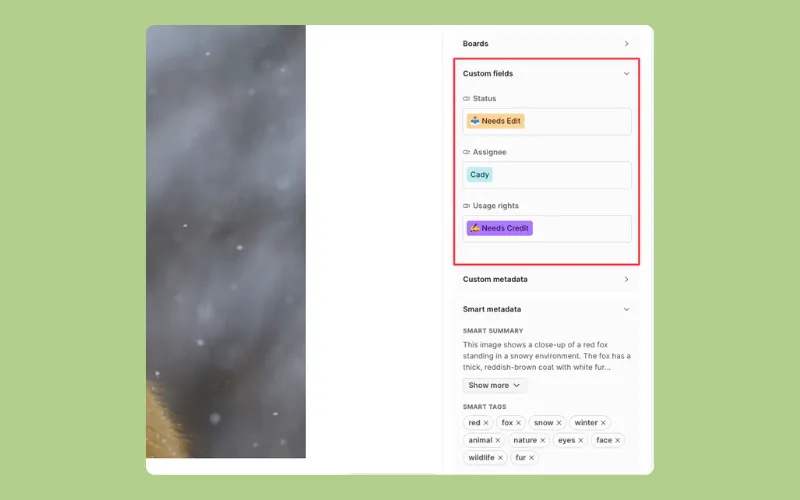 Start with a handful of metadata fields that match how people search, and add more only when usage calls for them. Then write down what "approved" means, who signs off at each step, and which assets are cleared for external use.
Stage 4: Governed
The latest approved version is obvious, feedback is attached to the file, and permissions decide what can go out externally.
In Air, Version Stacking places each new iteration on top of the original with full history, so working files and finals live together and the approved file is always clear. Visual annotation also allows reviewers to pin comments to a spot on an image or a timestamp on a video, so feedback stops living in Slack and email.
Governance here doesn't need a separate review board. Multi-stage approvals give each step an owner and a due date, Kanban views synced to custom fields show what's in review, and brand kits in Context hold fonts, colors, logos, and usage rules so outputs stay on brand. Smart Tags, version stacks, and custom fields also are on any Air plan, while the Enterprise plan adds access-controlled libraries, custom roles, and SSO.
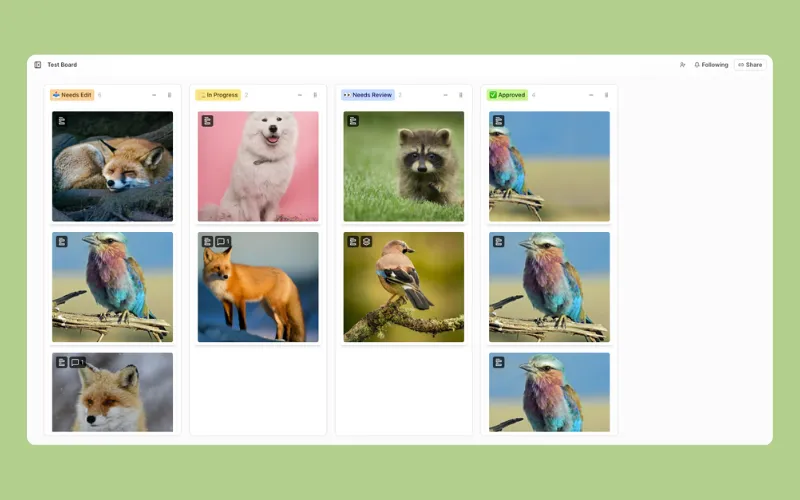 What it costs: Approved work still gets reused manually, one request and one resize at a time.
Next move: Keep approval status, usage rights, and brand rules on each asset rather than in a separate document, so search and agents can act on them. Keep that DAM governance structure lean, since rules nobody follows don't protect anything.
Stage 5: AI-ready
Your library has enough context, including approval status, versions, metadata, and brand rules, for search and agents to act on it reliably.
Teams aren't ready for AI at scale until their assets are organized, searchable, approved, and brand-aware. A blank model can't tell the hero image from the rejected draft beside it, but a library at this stage can, which is what makes Air's agent for creative tasks useful.
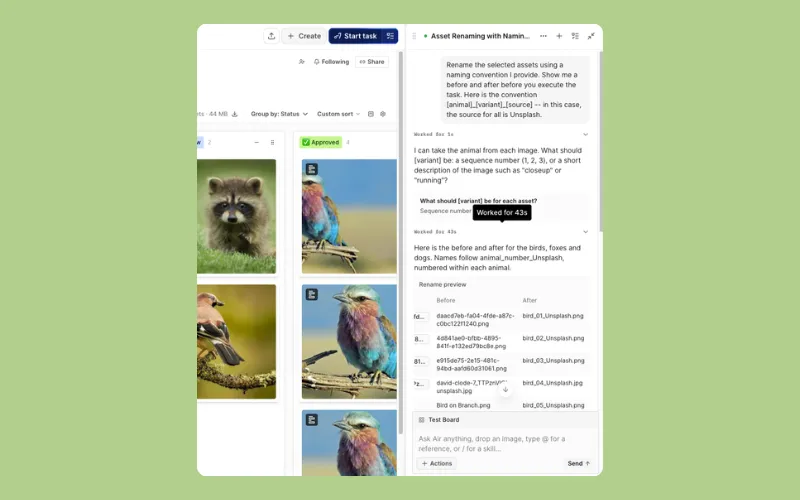 You can ask it to tag and rename thousands of assets from one plain-language instruction, find assets and then act on them, or turn one approved asset into the sizes and formats a campaign needs. Air Canvas does the same for editing, turning one approved design into hundreds of on-brand deliverables.
What it costs: If no one measures adoption and reuse, the library slowly slides back toward Stage 3.
Next move: Track adoption and reuse, and treat every new asset as something that should be findable and reusable on day one.
How to assess your team's DAM maturity
You don't need a full scoring spreadsheet for a first read. Answer these questions honestly, then map the answers to a stage.
Can marketing find approved assets without asking the designer? (Searchable)
Is the latest version obvious without opening three files? (Governed)
Is feedback attached to the asset, or scattered across email, Slack, and PDFs? (Governed)
Can anyone tell whether an asset is cleared for external use? (Governed)
Is there a named owner for the library? (Governed)
Would an AI search return the right asset today? (AI-ready)
How to score it: Your stage is the highest one where every question tagged at or below it gets a yes, because maturity is capped by the weakest link in the workflow. If the first answer is no, you're Stored if everything sits in one place, and Scattered if it doesn't. A team with great search and no approval rules is still Searchable, not Governed.
What to fix first:
Scattered teams consolidate sources
Stored teams fix tagging and search
Searchable teams add metadata structure
Governed teams tighten approvals, permissions, and external sharing rules
AI-ready teams focus on adoption, reuse, and integrations
Build the internal case. Name an owner and an internal champion, then pick two or three gaps from your self-check to close this quarter. Here’s a quick tip: tie the request to outcomes you can measure, such as less rework, faster campaign turnaround, and fewer off-brand assets in the market.
Baseline those numbers before you ask for a budget so the DAM ROI case rests on your own data. If the assessment points to a new platform, weigh the best DAM solutions against the stage you're trying to reach.
Move up a level without rebuilding from scratch
The DAM maturity model turns a vague question about tooling into a specific list of gaps you can fix: consolidate, make assets searchable, structure the metadata, govern versions and approvals, and then scale approved work.
Air is built for the later stages, where assets, versions, approvals, and brand context live in one workspace and an agent can act on the library. That's where digital asset management and creative operations meet, and it's how teams stop remaking what already exists and start building on what works.
See how Air can help your team understand, organize, and scale creative with a personalized product walkthrough.
DAM maturity model FAQs
What is the DAM maturity model?
The DAM maturity model is a framework from Real Story Group and the DAM Foundation, first published in 2012, that scores how well your assets, metadata, workflows, and ownership actually work, so you can see where your team stands and what to fix next. Air's own five-stage version for creative and marketing teams also judges each stage partly on whether search, tagging, and agents have enough context to act on the library.
What are the five levels of DAM maturity?
The original model's five levels are Ad hoc, Incipient, Formative, Operational, and Optimal. Air's simpler model for creative and marketing teams uses Scattered, Stored, Searchable, Governed, and AI-ready, running from files spread across drives and Slack to a library that search and agents can act on reliably.
How many dimensions does the DAM maturity model have?
Version 2.1 scores 15 dimensions across four categories: People, Information, Systems, and Processes. Air's simpler model skips formal dimensions and places your team with six questions covering findability, versions, feedback, external-use rights, ownership, and AI search.
How do we assess our own DAM maturity?
Answer Air's six self-check questions honestly, then find the highest stage where every question gets a yes, since maturity is capped by the weakest link in the workflow. A team with great search but no approval rules is still Searchable, not Governed.
What is the difference between a digital asset management maturity model and a DAM implementation plan?
A maturity model like Air's tells you which stage your team is at and what to fix first. A DAM implementation plan is the rollout that makes those fixes, covering the audit, migration, permissions, training, and check-ins.
Do we need a DAM to reach a higher maturity level?
A shared drive can get you to Stored, with everything in one place, but Searchable, Governed, and AI-ready depend on AI tagging, structured metadata, and version and approval status kept on each asset, which general cloud storage only partly provides.
How does Air help teams move up the maturity curve?
In Air, Cloud Imports move a team from Scattered to Stored, Smart Tags and Conversational Search make the library Searchable, and Custom Fields, Version Stacking, and approvals make it Governed. Once the library is AI-ready, Air's agent for creative tasks can act on that context to tag, find, and scale approved work.