



Updated: Nov 07, 2026
DAM ROI: How to Build the Business Case and Get It Approved
Table of contents
Where the cost of your current setup actually sits
What to measure before and after you buy
How to calculate the ROI of a DAM
What a DAM with AI adds to the classic business case
Build the case and then keep proving it
DAM ROI FAQs
The demos you’ve attended are done and the shortlist is down to one. Your team is ready, and now the next email goes to finance or the CMO, but this time it needs a strong number attached.
That number is where most digital asset management business cases stall. Features don't move a budget owner. What does is a clear gap between what the team spends today on file admin, remakes, and overlapping tools, and what it will spend once that work lives in one system. A case like this gets signed off when both halves of that equation, the value and the cost, are on the same page.
This guide covers where today's DAM costs sit, what to measure, a simple DAM ROI formula with the cost side built in, and what a DAM with AI adds.
Where the cost of your current setup actually sits
Most business cases lead with what the new tool does, but finance teams respond better to what the current setup costs.
The five cost centers below rarely get their own budget row, but each one shows up somewhere: in payroll, production spend, renewals, or a correction nobody planned for.
1. Hours lost to searching and "where's the latest?" requests
A marketer needs the hero image from last month's launch. They ping a designer, who checks Google Drive, then Slack, then an old project folder, and finally exports a fresh version to be safe. Twenty minutes gone, and it happens a few times a day across the team.
This cost gets absorbed as normal workload, which is exactly why it has to be measured before it can be argued. For context, Atlassian's State of Teams 2025 survey of 12,000 knowledge workers and 200 executives found that teams lose 25% of their time searching for answers.
If you want the full search-cost maths, we've broken it down in our guide on why creative teams spend more time searching for files than creating.
2. Reshoots and remakes of work you already own
A slow search costs hours. A failed search costs more, because the team then pays twice: once for the original asset and again to recreate it.
These are costs finance will easily recognise:
A reshoot that was booked because nobody could locate the raw files from the original one
A freelance edit commissioned for a version that already existed
A new social variant built from scratch because the approved master wasn't findable in time
Think of this as reuse economics. Every asset used three times instead of once lowers its effective cost, and a searchable library is what makes reuse possible at volume.
3. Overlapping tools doing roughly the same job
Look at a typical stitched stack:
Working storage for files in progress
Separate system for finals
Proofing or review tool
File transfer service
A project tracker
Each one has its own bill, and moving work between them adds a download-rename-re-upload tax every time.
Duplicate storage is often the easiest cost to prove because it sits right on a renewal statement. Candid's Creative Director, Andrew Peet, put it plainly when describing the team's setup before Air: "We were paying Google Drive and Dropbox thousands of dollars every quarter to do essentially the same function."
That's why consolidation is often the first DAM use case to make the case for: a team shouldn't need a DAM for finals and a separate storage tool for working files. As we wrote in our guide, what is Air?, "A DAM that needs a whole stack bolted around it is a hard purchase to defend to finance."
For a line-by-line look at what teams pay across that stack, see our guide on Air's pricing.
4. Per-seat licences that push teams to ration access
When every login costs money, teams limit who gets one. The people who need approved assets most, such as sales, regional marketers, and agency partners, end up requesting files through a designer instead of finding them directly.
That turns a software saving into a labor cost, because every withheld seat creates recurring interruptions for whoever holds the keys. This never appears directly as a line item, but it belongs in the business case anyway.
5. Off-brand, outdated, or expired-rights assets going live
An old logo shows up in a retail partner's email, or a model shot runs after its licence window has closed.
The cost here is correction and risk rather than hours: reprints, takedowns, legal review, and an apology to a partner. Even a single incident is often the clearest argument a brand lead can make. This usually traces back to version confusion, where the wrong file was simply the easiest one to find.
What to measure before and after you buy
Credible DAM ROI depends on baselines captured before implementation, and you don't need a data team to get them. Sample two or three recent campaigns over a week or two rather than auditing everything.
Capture these baseline metrics, using the method next to each:
Metric | How to capture it |
File-admin hours per person per week | A one-week self-reported time log covering searching, versioning, exporting, and sharing |
Inbound asset requests | Count requests in Slack and email over two weeks |
Asset reuse rate | Of last quarter's finals, how many were used more than once |
Current tool spend | Pull every storage, proofing, transfer, and DAM invoice |
Approval cycle time | Date of first upload to date of final sign-off on recent projects |
Wrong-version or off-brand incidents | Count over the last two quarters |
Then re-measure the same metrics after launch. Each stage tends to surface something different:
30 days: search time and request volume, since these change first once assets are findable
60 days: approval cycle time, once reviews run through the new system
90 days: reuse rate and duplicate-work reduction, which need a full campaign cycle to show up
One little thing to note: time logs and invoices are defensible because finance can actually check them. Percentage-based "productivity uplift" figures borrowed from a vendor's calculator are not. If you can't source an assumption or re-derive it from your own data, drop it from your analysis.
How to calculate the ROI of a DAM
Here are two formulas finance will accept, because every input traces back to a baseline:
DAM ROI = (annual value recovered − total annual cost) ÷ total annual cost
Payback period = total first-year cost ÷ monthly value recovered, expressed in months.
The value side
Tie each input to a metric from the previous section:
File-admin hours recovered x fully loaded hourly rate
Remakes and reshoots avoided x average production cost of each
Retired tool licences, taken straight from the invoices you pulled
Production hours saved on channel adaptations (more on this in the AI section below)
The cost side
This is the half most business cases skip, but you should include all of it:
Licence cost
Migration of existing archives
Internal setup time for taxonomy, metadata fields, and permissions
Training
Ongoing administration
An illustrative example for a 25-person team
Note: Every figure below is a round placeholder, not a benchmark. Swap in your own numbers for a more accurate look at your specific business.
First up, the value side:
Value side | Example inputs | Example annual value |
File-admin hours recovered | 25 people × 1 hr/week × 46 weeks × $60/hr | $69,000 |
Remakes avoided | 10 remakes × $1,500 | $15,000 |
Retired tool licences | Two overlapping tools | $12,000 |
Adaptation hours saved | 400 variants × 0.5 hr × $60/hr | $12,000 |
Total value | $108,000 |
Then, the cost side:
Cost side | Example inputs | Example annual cost |
Licence | Vendor’s price | $15,000 |
Migration | One-time | $5,000 |
Setup time | 80 hrs × $60/hr | $4,800 |
Training | 25 people × 2 hrs × $60/hr | $3,000 |
Ongoing admin | 2 hrs/week × 46 weeks × $60/hr | $5,520 |
Total cost | $33,320 |
With those stand-ins, ROI works out to ($108,000 − $33,320) ÷ $33,320, or roughly 224%.
Payback is $33,320 ÷ $9,000 a month, which is just under four months.
Keep the case conservative and it's more likely to survive review. Leave out:
Speculative revenue lift
Headcount reduction you have no intention of making
Any benchmark you can't attribute to a named, checkable source
The point is that finance can follow every line back to a time log, an invoice, or a production budget.
What a DAM with AI adds to the classic business case
The traditional DAM case rests on one idea: find assets faster. An AI-powered library adds two more. It removes the manual tagging that usually kills adoption, and it absorbs part of the production work itself. That means you can count organization time and adaptation time, not just search time.
Tagging and search that don't depend on manual upkeep
Most DAM ROI projections quietly assume someone will maintain the taxonomy forever, and search quality drops the moment they stop.
Air applies Visual Recognition and smart tagging as files upload, so assets become searchable by what's in them (objects, colors, and concepts) without anyone labeling them by hand. Conversational Search lets a marketer type a plain-English query instead of needing to know the filename.
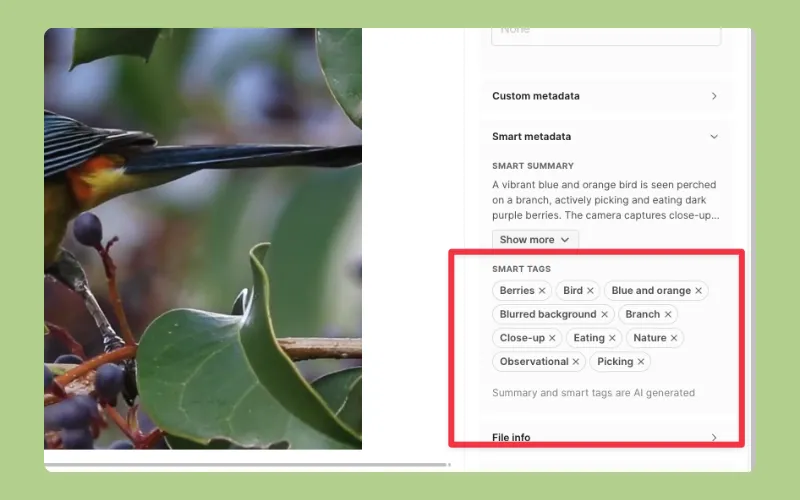 For archives that arrive messy, Air's agent for creative tasks can add consistent tags and rename thousands of assets from a single instruction, so a migrated library becomes usable without a cleanup project nobody finishes.
Here's what a searchable library looks like as one person's time. Pattern's Daniel Batten described spending "at least 12-15 hours" a week in Dropbox "sorting out assets, trying to locate stuff for people." In Air, he said, it's now "1 or 2 hours a week, max."
Candid tells a similar story at the individual level. Before Air, Lead Brand Designer Carly "spent up to 20% of her week finding assets for people. Now it's around 2%."
Graza's Social Media and Influencer Consultant, Kendall Dickieson, counts it in days: "Air saves me, over the course of a month, around three days of time. That's hours I'm not following up with people to find assets and hours I'm not spending discussing approvals with different social teams."
Adapting approved work instead of rebuilding it
This is the line item most DAM business cases miss entirely: the hours spent turning one approved asset into the sizes, formats, and localized versions each channel needs.
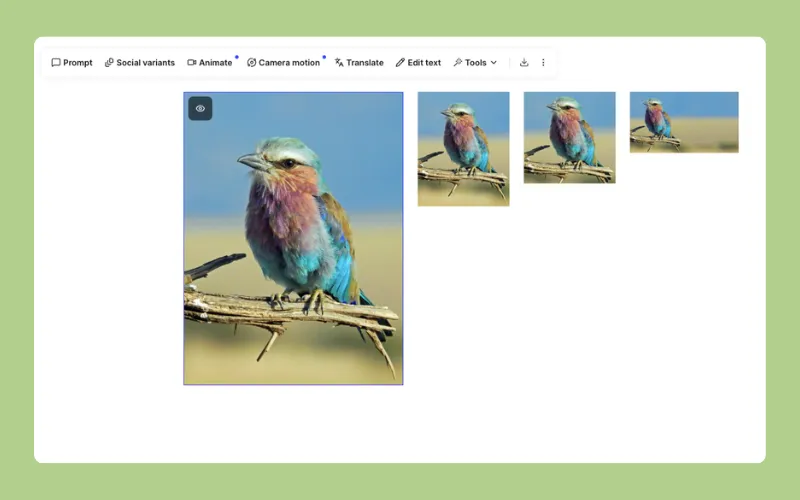
Air Canvas is a context-powered AI design and editing surface that turns one approved design into hundreds of on-brand deliverables. It draws on the brand kits your team sets up in Context (fonts, colors, logos, and usage rules), so adapted outputs stay on brand without an extra review round. Skills let the team save a repeatable edit once, then run it across a batch of assets whenever it's needed.
To count it, take a recent campaign and multiply the number of variants by the hours each one took. That's production time you can recover, and it goes straight into the value side of the formula.
Consolidation and access that don't get more expensive
Keeping working files and finals in one system removes duplicate storage and the download-re-upload cycle between tools.
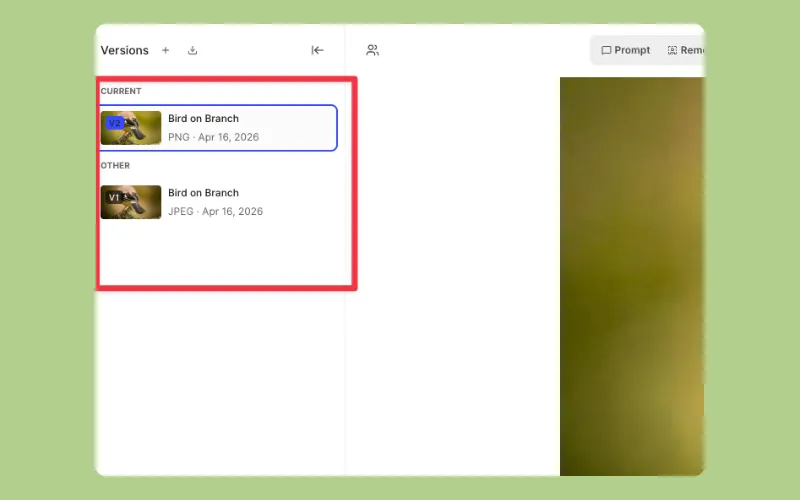
For example, in Air, Version Stacking keeps the current approved file on top of its history, multi-stage approvals record who signed off and when, and users can pin feedback to the exact spot on the asset. Together they close off the wrong-version incidents described earlier.
 Pricing matters here too. Air's Business and Enterprise plans include unlimited users, so the cost of the system doesn't climb as access widens to clients and stakeholders, and the rationing problem from earlier goes away.
If you're weighing heavier enterprise systems, our guide to the best enterprise DAM software compares pricing transparency and implementation lift, and Air vs. enterprise DAM covers where Air fits next to a legacy enterprise system.
Build the case and then keep proving it
DAM ROI comes from documented current spend plus measured change, not from a vendor's hypothetical percentage.
The path to a credible DAM business case is relatively short:
Measure the baseline across two or three recent campaigns
Price the full cost of today's stack, invoices included
Model the formula with your own numbers, cost side and all
Re-measure at 30, 60, and 90 days, and report back
When you're ready to plan the rollout itself, our DAM implementation guide covers migration and adoption step by step. And if you want to see how these numbers play out for Air specifically, the business case for Air picks up where this guide leaves off.
Air is a DAM with AI where the same library that cuts search time also adapts approved work for every channel. Working files, finals, feedback, approvals, and versions stay in one visual system of record, so creative teams set the standard and marketing teams run from it.
Ready to put a starting figure in that email? Try the ROI calculator on Air's enterprise page. It takes your headcount, weekly file-admin hours per person, and total storage, and returns a directional estimate you can refine with the baselines above.
DAM ROI FAQs
How do you calculate the ROI of a DAM?
Subtract the total annual cost of the system (licence, migration, setup, training, and admin) from the annual value it recovers, then divide by that total cost. Value comes from file-admin hours recovered, remakes avoided, retired tools, and adaptation time saved, each tied to a measured baseline.
What should a digital asset management business case include?
It should include baseline measurements of today's costs, the full cost of the new system, a simple ROI and payback calculation, and a plan to re-measure after launch. Leave out speculative revenue lift and any benchmark you can't attribute.
Is a DAM worth it for a mid-sized team?
Usually, once the team is losing measurable hours to searching, paying for overlapping storage, or remaking assets it already owns. Check the pricing model too, since per-seat licences make wide access expensive.
How long does it take to see ROI from a DAM?
Search time and request volume change first, so check them at 30 days. Approval cycle time shows up around 60 days, and reuse rate needs a full campaign cycle, so check it at 90.
What should we measure before we migrate off Google Drive or Dropbox?
Log file-admin hours per person for a week, count asset requests for two weeks, and pull every storage and tool invoice. Add recent approval cycle times and wrong-version incidents for a clean before-and-after comparison.