



Published: Nov 21, 2026
Best DAM Software for CPG Brands Going Into 2027
Table of contents
1. Air: best for CPG teams that need approved assets to scale across channels
2. Canto: best for lean CPG marketing teams that need a searchable library fast
3. Bynder: best for multi-brand CPG groups that need brand portals and guidelines
4. Aprimo: best for enterprise CPG teams that need content operations and compliance workflows
5. Tenovos: best for enterprise CPG brands focused on asset metadata depth and omnichannel delivery
6. Focal: best for CPG performance teams running high-volume paid social creative
What to look for in your CPG DAM solution
Best DAM software for CPG brands FAQs
The packaging refresh shipped to the retailer on Tuesday. On Thursday, the agency building the new product page pulled the label from a shared Drive folder, and it was last season's version. The PDP went live with a claim the brand had already dropped.
That's why CPG asset management is a different job from DTC or general ecommerce. A consumer goods brand manages SKU-level packshots, retailer-specific specs, expiring rights on talent and UGC, sometimes several brands at once, and a hand-off into a PIM or storefront. Digital asset management for CPG has to hold all of it, so the best DAM software for CPG brands is the one that keeps the latest approved version obvious and scales it to every channel.
This guide judges six tools on five jobs: keeping packaging and SKU versions straight, getting the right spec to each retailer, tracking usage rights on talent and UGC, running several brands in one place, and connecting to a PIM or storefront. It draws on vendor documentation, pricing pages, and G2 ratings. Air publishes this guide, and there's no single best DAM for CPG brands, only the best fit for your asset volume, brand count, retailers, and team size. For options beyond consumer goods, see the best DAM solutions across the wider market.
Tool | Best for | Standout CPG capability | G2 rating |
Air | CPG teams scaling approved assets across channels | Version Stacking plus Air Canvas for retailer and channel variants | 4.6 out of 5 |
Canto | Lean teams that need a searchable library fast | AI search, portals, and a Retail Suite with Amazon and Shopify connections | 4.4 out of 5 |
Bynder | Multi-brand groups that need portals and guidelines | Brand portals with access and usage rights by audience | 4.5 out of 5 |
Aprimo | Enterprise teams with regulated claims review | Compliance checks and audit history | 4.3 out of 5 |
Tenovos | Enterprise brands focused on metadata and omnichannel delivery | Configurable metadata and publishing to ecommerce and syndication | No ratings yet |
Focal | Performance teams running high-volume paid social | Ad performance data connected to each creative | 4.7 out of 5 |
1. Air: best for CPG teams that need approved assets to scale across channels
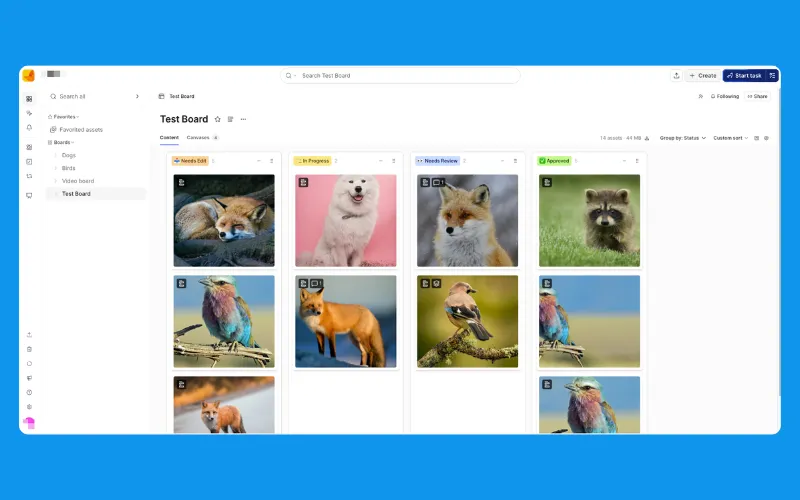 Air is an agent for creative tasks built for brands that produce high volumes of visual content. It keeps packshots, packaging files, campaign assets, and video in one visual workspace, with versions, feedback, and approvals attached to each file. A DAM stores what you made. Air remembers why you made it and helps marketing scale approved work to each retailer, PDP, and paid channel without going back to the creative team.
Air for CPG teams shows how a product asset moves from shoot to shelf.
Standout features
Boards and Version Stacking: In Air, one packshot can sit in SKU, campaign, and retailer boards at once without duplicating storage, and each packaging revision stacks on the original so the approved file stays on top.
AI search: Auto-tagging, custom object recognition for products and logos, and OCR for text on labels and PDFs.
Air Canvas: A context-powered AI design and editing surface that turns one approved design into hundreds of on-brand deliverables, using the brand kits your team builds in Context. Skills and batch edits run a background swap or logo replacement across many SKU assets at once.
Approvals on the asset: Pinned comments plus multi-stage approvals with owners, due dates, and notifications.
Partner sharing: Upload links for agencies and photographers, secure share links, and Showcases. Expiring links and Showcase branding are on Business and Enterprise.
Governance and distribution: Usage rights and expiration dates live as Custom Fields on each asset, and on Enterprise, access-controlled libraries segment content by brand, region, or team. CDN links (Business and Enterprise) and current-version links (in beta) keep published assets current, and Shopify, Sanity, and WordPress integrations are on Enterprise.
Strengths
Air offers structural version clarity: versions stack instead of multiplying, so no one grabs an outdated label from a forgotten folder. A brand manager can find an approved hero, reframe it for TikTok, remove the background for a retailer template, and download it without a design request.
Cloud imports from Google Drive, Dropbox, Box, and SharePoint also make migration lighter than with a legacy DAM.
Graza: The olive oil brand marks each creator asset as approved for specific channels so its paid social agency pulls only what's cleared, which saves its social consultant "around three days of time" a month.
Pattern: Associate Creative Director Daniel Batten went from 12 to 15 hours a week finding files in Dropbox to one or two hours in Air, and Pattern now runs four brands on Air.
David Protein: Each retail account manager owns an Air board for their accounts, and Air's agent tags assets by SKU so the current packaging and PDP version is the one that surfaces.
Limitations
Air isn't a PIM, so it doesn't manage product attributes, pricing, or catalog syndication. Pair it with a PIM if product data is your bottleneck; our PIM vs DAM breakdown explains the split.
The Shopify integration, access-controlled libraries, and SSO are Enterprise only, and the Shopify app publishes static copies rather than syncing.
For governance, Air adds custom roles, SSO, and automated content expiration on Enterprise, plus admin activity logs, though very large organizations may run it alongside an enterprise DAM.
Pricing
Air offers Free, Starter, Business, and Enterprise plans. Free covers up to 3 users and Starter up to 5, while Business and Enterprise include unlimited users. AI actions use monthly credits, storage is separate, and every plan gets the same AI models. Eligible startups and nonprofits can get reduced pricing. See the pricing page for current details.
Best for
Challenger brands that have outgrown Drive or Dropbox
Lean creative teams fielding constant requests from marketing
Omnichannel brands shipping retailer, Amazon, paid social, and email variants from one approved master
Multi-brand groups on Enterprise that want separate libraries without separate tools
G2 rating: 4.6 out of 5
2. Canto: best for lean CPG marketing teams that need a searchable library fast
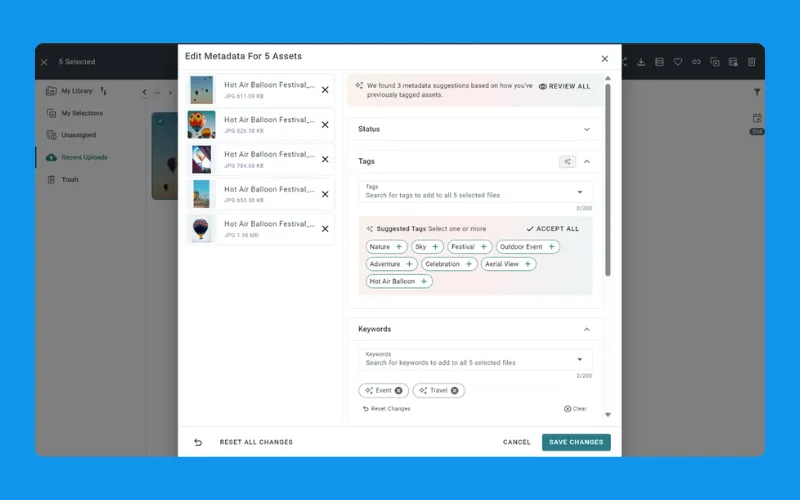 Image source: Canto
Canto is a long-standing DAM built around search, organization, and distribution. It suits CPG marketing teams whose first priority is making existing product photography findable, and its retail packages add product data and storefront connections for brands that need them.
Standout features
AI Visual Search and an AI Library Assistant that applies taxonomy-aware metadata
Unlimited portals and style guides for sharing curated sets with retailers, distributors, and sales teams
Digital rights management and expiration controls on assets
AI Quick Edit for resizing, cropping, and adapting assets inside Canto
A DAM Retail Suite with a Product Hub, retailer-specific catalogs, an Amazon export assistant, and Shopify and Amazon integrations
Strengths
Strong library search and unlimited end users keep portal access open to retailers and sales teams without per-seat math.
For brands that need product data and retailer exports alongside the library, the Retail Suite brings more of that work into the DAM than most mid-market tools.
Limitations
Approval Hub and Brand Studio sit in the Brand Suite while retail features sit in the Retail Suite, both built on Canto's DAM Pro package, so a lean team should check which package covers both.
Its AI covers quick edits like resizing and cropping, plus on-brand templates in the Brand Suite, so deeper channel adaptation from an approved master usually still runs through design tools.
Pricing
Quote-based, scaling with team size and storage. Canto's pricing page shows illustrative packages (DAM Essentials, DAM Plus, DAM Pro, DAM Retail Suite, and DAM Brand Suite) and notes that every plan is customized, so confirm current packaging with Canto.
Best for
Small CPG marketing teams that mainly need a searchable product photo library
Brands that outsource creative production to agencies
Teams that want retailer catalogs and Amazon exports managed alongside brand assets
G2 rating: 4.4 out of 5
3. Bynder: best for multi-brand CPG groups that need brand portals and guidelines
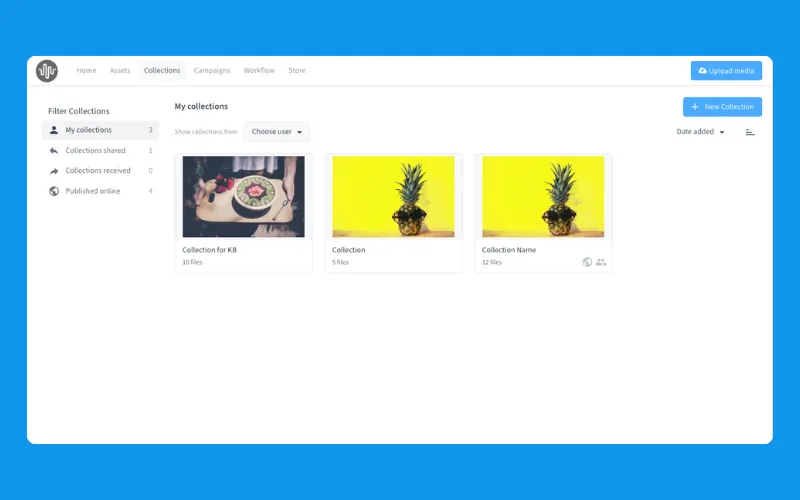 Image source: Bynder
Bynder is an established enterprise DAM known for brand portals and digital brand guidelines. It fits CPG groups running several brands, regions, and distributor networks, where each audience should see only the approved assets it's cleared to use.
Standout features
Digital brand guidelines and portals for publishing approved logos, packaging artwork, and claims to internal teams, retailers, and regional partners
Asset Workflow for review and approval routing, plus Studio for templated image and video production
Access and usage rights by team, agency, or partner, with automatic go-live and expiration dates on key assets
A large integration marketplace, including PIM, commerce, and martech connections for product content syndication
Strengths
Governance across many brands and markets is a core design strength, not an add-on.
Its integration catalog and partner ecosystem are mature, which matters when your DAM has to feed a PIM, storefronts, and regional sites at once.
Limitations
Implementation is a project: taxonomy design, migration, and admin setup usually need internal ownership or paid services.
Lean teams may find it heavier to adopt than a visual-first tool, and products like Studio and Content Workflow are typically priced as separate lines on the quote.
Pricing
Custom quotes based on users, storage, products included, and support level. Expect a demo, an annual contract, and module-based packaging.
Best for
Multi-brand CPG holding companies
Brands distributing artwork to international markets and retail partners
Teams with a dedicated DAM admin or creative operations function
G2 rating: 4.5 out of 5
4. Aprimo: best for enterprise CPG teams that need content operations and compliance workflows
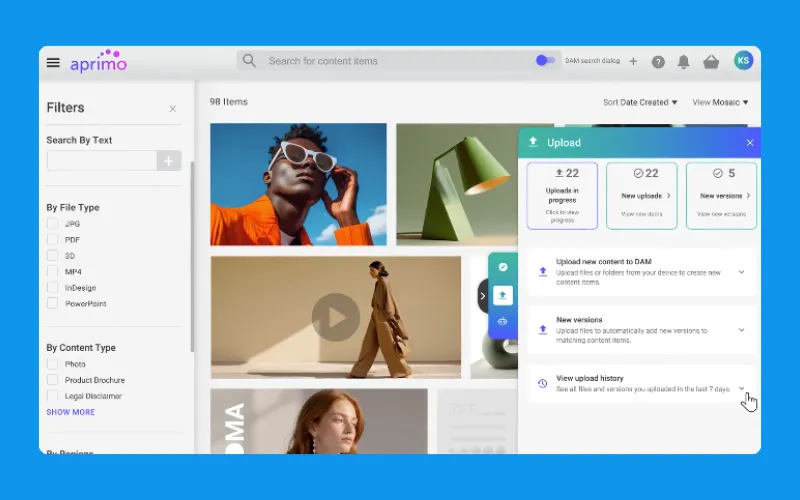 Image source: Aprimo
Aprimo pairs DAM with content operations and governance tooling. Regulated CPG categories like food, beverage, supplements, and personal care look at it when claims review, legal sign-off, and audit trails are part of every launch.
Standout features
DAM combined with content operations, so planning, workflow, and asset production are tracked in one system
Multi-step review and approval chains with audit history for claims and packaging copy
Rights and expiration tracking, plus Content Portfolio Management, which uses AI agents to flag outdated claims and expired approvals across connected storage
Creative templating and AI features for tagging and routing content
Strengths
Compliance-heavy approval chains are first-class functionality, which keeps review out of email and Slack.
For a regulated category with documented sign-off on every claim, Aprimo goes further on audit trails than a creative-first platform like Air.
Limitations
Aprimo is built for enterprise scale, so pricing and implementation effort are hard to justify for a challenger brand or lean team.
Its strength sits upstream in planning, governance, and approvals rather than in adapting approved creative for channels, and admin and training needs are significant.
Pricing
Custom, quote-based pricing, with implementation and onboarding typically scoped separately.
Best for
Large CPG organizations with regulated claims review
Marketing teams that want content operations alongside DAM
Brands that need documented audit trails on every approval
G2 rating: 4.3 out of 5
5. Tenovos: best for enterprise CPG brands focused on asset metadata depth and omnichannel delivery
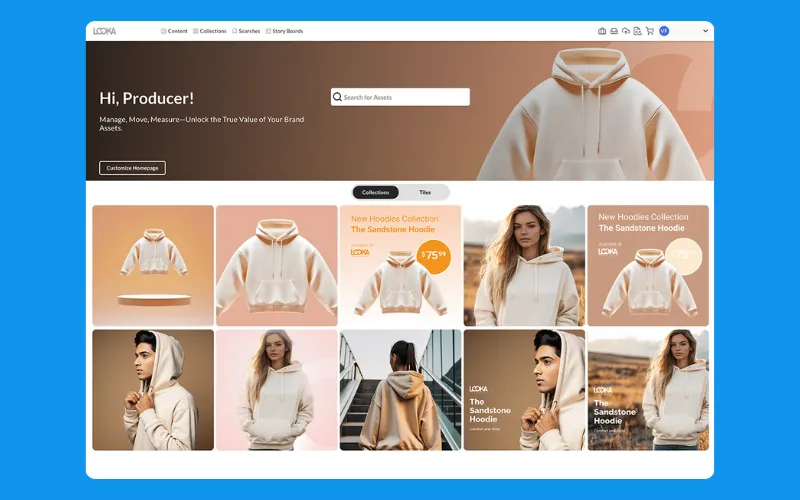 Image source: Tenovos
Tenovos is a data-first enterprise DAM positioned as the foundation of a brand's content supply chain. It suits CPG teams pushing the same product and campaign assets to retailers, marketplaces, and owned channels at high volume.
Standout features
Configurable metadata for SKU, product line, campaign, channel, and market attributes
Rights kept alongside each asset, with the ability to revoke outdated content
Review, annotation, and approval workflows, plus adaptive brand templates
Automatic rendering and publishing to ecommerce, syndication, social, web, and email
Usage and performance reporting that ties creative to return on asset
Strengths
Structured metadata at SKU and channel level supports the filtering CPG teams need when one product has dozens of retailer variants.
Connecting asset usage to performance data also helps justify creative spend to leadership.
Limitations
Tenovos is aimed at enterprise buyers, so smaller brands may find it more platform than they need.
Its value depends on disciplined metadata governance, which lean teams rarely sustain without a dedicated owner.
Pricing
Tenovos doesn't publish pricing. Expect a demo and scoping conversation to get a quote.
Best for
Enterprise CPG brands with large SKU counts
Teams syndicating assets to many retail and marketplace endpoints
Organizations with a metadata owner on staff
G2 rating: No ratings yet (as of Nov, 2026)
6. Focal: best for CPG performance teams running high-volume paid social creative
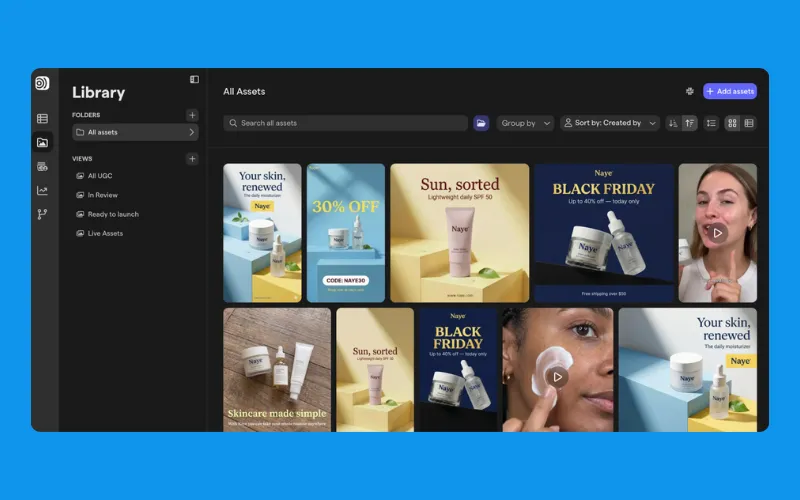 Image source: Focal
Focal describes itself as a performance DAM for ad teams. It lands on CPG shortlists when the creative team's main output is paid social, with dozens of ad variants per SKU and a need to see which ones win.
Standout features
AI tagging and search across an ad creative library
Boards that combine project management with asset review and approval
Automated naming conventions and direct publishing to Meta, TikTok, and Google
Ad performance data connected to each creative, plus API and MCP access
Strengths
Focal's clearest advantage is the loop between production and performance.
Seeing which concept won on Meta next to the asset itself helps a performance team decide what to brief next.
Limitations
Focal is built around ad creative and ad channels.
Packaging version control, retailer spec delivery, and PIM or storefront connections aren't its focus, so confirm those in a demo if retail is part of the job.
Its published plans also cap assets and ad spend by tier.
Pricing
Focal publishes Starter, Plus, and Growth tiers in euros, plus a custom Enterprise plan. Plans scale by seats, assets, automations, ad accounts, and monthly ad spend, so check current limits on Focal's pricing page.
Best for
Performance marketing teams producing high volumes of paid social variants
CPG brands whose creative bottleneck is ad testing rather than packaging or retail
Teams that want ad performance and creative assets in the same view
G2 rating: 4.7 out of 5
What to look for in your CPG DAM solution
Test every shortlisted DAM against the five CPG jobs, using your own packaging files:
Version clarity: How does it make the latest approved label, claim, and packshot unmistakable, and can an old version still be pulled by accident?
Retailer and channel specs: Can a marketer produce an Amazon, retailer, paid social, or email variant from an approved master without a design request?
Usage rights: Do rights and expiration dates live on the asset as fields you can filter?
Multi-brand separation: Can brands or regions get their own access controls inside one workspace?
Product data: What does it do with product attributes? If catalog feeds are the bottleneck, plan for a PIM alongside the DAM.
Migration: How do archives move out of Drive, Dropbox, Box, or SharePoint, and how soon will the team use it?
In Air, Version Stacking keeps the approved packaging file obvious, usage rights live as a custom field on each asset, and Canvas lets marketing build channel variants from approved masters.
Stop remaking what already exists and start building on what works. See how Air can help your team understand, organize, and scale creative with a personalized product walkthrough.
Best DAM software for CPG brands FAQs
What is the best DAM for CPG brands?
The best digital asset management software for CPG brands depends on your team. Air fits teams scaling approved assets across channels, Bynder suits enterprise multi-brand groups, Tenovos suits enterprise brands syndicating to many channels, Aprimo suits regulated claims review, Canto suits lean teams that mainly need search, and Focal suits paid social performance teams.
Do CPG brands need both a PIM and a DAM?
Many do. A PIM manages product data like attributes, pricing, and feeds, while a DAM manages the creative and its approvals.
How do CPG teams share assets with retailers and distributors?
Most use portals or secure share links that expose only approved assets. In Air, teams use password-protected links (Business and Enterprise), Showcases, and access-controlled libraries (Enterprise).
How can a CPG team keep packaging versions and claims straight across launches?
Keep packaging in one system where new versions stack on the original and approval status sits on the asset, as Version Stacking and Custom Fields do in Air.
Can one DAM support multiple CPG brands in the same company?
Yes, if it segments content by brand with its own access controls. In Air, access-controlled libraries (Enterprise) partition content by brand, and Pattern runs four brands from one workspace.
How do CPG brands track usage rights on talent and UGC assets?
Store rights and expiration dates as fields on each asset. In Air, they're Custom Fields you can filter, and Facial Recognition helps find every asset featuring a given person.
When is a CPG brand ready to move off Google Drive or Dropbox?
When people can't find the current approved file without asking, or an outdated label has already gone live.